PV Law LLPPV Law LLP2026-09-04T12:28:01Zhttps://www.pvuslaw.com/feed/atom/WordPress/wp-content/uploads/sites/1604885/2025/01/cropped-og-image-purple-1-32x32.jpgby Bradford Cangro<![CDATA[Federal Circuit Extends Dynamic Drinkware’s Written-Description Requirement for AIA Prior Art: Dental Monitoring v. Align Technology]]>https://www.pvuslaw.com/?p=502742026-08-11T20:52:40Z2026-08-11T20:52:40ZIntroduction
On August 10, 2026, the Federal Circuit vacated and remanded a Patent Trial and Appeal Board (“PTAB”) decision that had invalidated all challenged claims of Dental Monitoring SAS’s U.S. Patent No. 10,755,409 (“the ‘409 patent”) in an inter partes review brought by Align Technology, Inc. It held that a reference patent or published application cannot claim the benefit of an earlier provisional filing date for prior art purposes under AIA 35 U.S.C. § 102(d)(2) unless the provisional application actually satisfies the written description requirement of § 112(a) for at least one claim of the later-filed application. In doing so, the court rejected the PTAB’s position, following in its own precedent, that only “ministerial” compliance with the priority-claiming formalities of §§ 119 and 120 is required. The case effectively extends the pre-AIA rule of Dynamic Drinkware, LLC v. National Graphics, Inc. into the AIA framework.
Background
Align Technology challenged claims 1–15 of Dental Monitoring’s ‘409 patent in an inter partes review. The PTAB found the claims obvious over a combination of three references, including a patent publication referred to as “Carrier.”
Carrier’s status as prior art depended on whether it could receive the filing date of its provisional application, because that provisional was filed before the effective filing date of the ‘409 patent, while Carrier’s non-provisional application was filed afterward.
Dental Monitoring argued that, under Dynamic Drinkware, Carrier could receive the benefit of its provisional filing date only if the provisional provided written-description support for at least one claim of Carrier. Align argued that Dynamic Drinkware was limited to pre-AIA law and that, under the PTAB’s precedential decision in Penumbra Inc. v. RapidPulse, Inc., the provisional need only disclose the subject matter relied upon as prior art and satisfy the applicable “ministerial” priority requirements.
The PTAB agreed with Align and treated Carrier as prior art as of the provisional filing date.
Federal Circuit's Decision
The Federal Circuit reviewed the PTAB’s legal conclusions de novo and vacated. The Federal Circuit grounded its decision in the statutory text of § 102(d)(2), which provides a reference with an earlier effective filing date only if the reference “is entitled to claim a right of priority under [§] 119.” Section 119(e)(1) in turn requires that the invention be “disclosed in the manner provided by [§] 112(a).” Reading these provisions together, the court held that § 102(d)(2) incorporates § 112(a)’s written description requirement, and that the phrase “entitled to claim a right of priority” denotes substantive entitlement, not the mere procedural act of claiming priority.
The panel rejected both of Align’s arguments for the PTAB’s contrary reading. First, it characterized Dynamic Drinkware’s footnote reserving the AIA § 102(d) question as a reservation of decision, not a determination that the AIA abandoned the written description requirement. In addition, the Federal Circuit noted that the policy concern Dynamic Drinkware addressed, namely preventing a challenger from manufacturing an artificially early prior art date, remains equally valid under the AIA. Second, the court held that the AIA’s structural distinction between a claimed invention’s effective filing date (§ 100(i)) and a reference’s effective prior art date (§ 102(d)) says nothing about what substantive showing “entitled to claim” priority requires, rather it merely identifies which inquiry is being performed. The court also declined to credit legislative statements suggesting a “ministerial” standard, reiterating that unambiguous statutory text controls over extrinsic legislative history.
Notably, the court observed in a footnote that the PTAB’s own Penumbra decision, the precedent underlying its “ministerial” standard, had been affirmed by the Federal Circuit only under Rule 36, without opinion, and therefore carries no precedential weight of its own. A Rule 36 affirmance only establishes that the judgment was correct. It does not endorse or reject the underlying reasoning for the judgment.
Because the PTAB had not made factual findings on whether Carrier’s provisional application actually provides § 112(a) written description support for any claim of Carrier, the court vacated and remanded the decision for the PTAB to make that determination in the first instance.
Conclusion
Dental Monitoring v. Align Technology supplies precedential clarity on a question the PTAB had answered inconsistently in the years since the AIA: a reference cannot borrow an earlier provisional filing date for prior art purposes under § 102(d)(2) without satisfying § 112(a)’s written description requirement for at least one claim of the reference. Practitioners should take note of several practical implications:
IPR petitioners relying on a reference’s provisional priority date to establish an earlier effective filing date should be prepared to show that the provisional application provides written description support for at least one claim of the reference patent or application.
Patent owners facing prior art references that depend on an earlier provisional filing date now have a clearer, precedential basis to challenge that date by attacking the provisional’s written description sufficiency, mirroring pre-AIA Dynamic Drinkware practice.
The decision also serves as a reminder that Rule 36 affirmances carry no precedential force. The PTAB’s reliance on Penumbra as settled law was itself vulnerable, and parties should scrutinize whether PTAB precedent rests on non-precedential appellate outcomes before treating it as settled.
]]>by PV Law LLP<![CDATA[Brad Cangro Named to Lawdragon’s List of 500 Leading Global IP Lawyers 2026]]>https://www.pvuslaw.com/?p=502472026-06-23T21:05:26Z2026-06-23T21:05:26Z]]>by Jacob Snodgrass<![CDATA[Verdict Form Must Seek Infringement Findings for Each Patent Separately]]>https://www.pvuslaw.com/?p=502462026-06-16T15:38:25Z2026-06-16T15:38:25ZOllnova Techs. Ltd. v. ecobee Techs. ULC, Appeal Nos. 2025-1045, -1046 (Fed. Cir. June 4, 2026), the court found fault with the district court’s verdict form, which simply asked only one question regarding infringement, specifically whether the defendant had infringed “any” of the asserted claims of the asserted patents.
Procedural Background
The Ollnova appeal arrived at the Federal Circuit after a trial in the United States District Court for the Eastern District of Texas. In relevant part, both sides had proposed that the jury verdict include at least one separate question for each asserted patent. The plaintiff proposed only one question per patent, and the defendant proposed a separate question for each asserted claim. The district court nevertheless adopted a verdict form with only a single question: “Did Ollnova, the Plaintiff, prove by a preponderance of the evidence that ecobee, the Defendant, infringed ANY of the Asserted Claims of the Asserted Patents?” The jury returned a verdict that, in relevant part, answered this question in the affirmative.
The Federal Circuit Decision
The Federal Circuit found that the jury verdict was “materially identical” to that in a case from last year—Optis Cellular Tech., LLC v. Apple Inc., 139 F.4th 1363 (Fed. Cir. 2025)—in which the court articulated the requirement for infringement determinations to be indicated patent-by-patent. In Optis, the objectionable verdict form asked, “Did [plaintiff] prove by a preponderance of the evidence that [defendant] infringed ANY of the [a]sserted [c]laims?” The high degree of similarity between the verdict form in Optis and that at issue on appeal was essentially the end of the matter.
The Federal Circuit had already established in Optis that an infringement question covering multiple patents violates a defendant’s Seventh Amendment right to a unanimous verdict. Specifically, it allows a jury to answer “Yes” even though not all jurors believe that the defendant infringed any one patent. For example, some jurors may believe that one patent was infringed but not others, while the remaining jurors may believe that only another patent was infringed.
The Federal Circuit rejected the plaintiff’s argument that the jury verdict became acceptable when viewed alongside the jury instructions. Those instructions, the plaintiff argued, made clear the requirement of unanimity. The Federal Circuit noted that the same argument was raised in Optis, and responded that “the jury could have followed those instructions yet understood that it only needed to be unanimous as to the question presented on the verdict form—whether defendant infringed ‘ANY’ of the asserted claims—not whether defendant infringed the same patent.”
Accordingly, just as it had done in Optis, the Federal Circuit determined that the district court abused its discretion in adopting the single-infringement-question verdict form. The court vacated the infringement judgment and remanded.
The Federal Circuit did not—because it was not asked to—resolve whether a proper verdict form needs to break out each patent claim separately. Instead, it only raised the issue in a footnote, stating that “[w]e need not reach the issue . . . because ecobee [defendant] argues only that the verdict form should have broken up the infringement question on a patent-by-patent basis.” This is consistent with the Optis case, in which the Federal Circuit volunteered that the parties had not presented it with that issue. Accordingly, it remains open whether a verdict form is sufficient if it asks only one infringement question per patent when multiple claims per patent are asserted.
Conclusion
Under Ollnova, accused infringers should ensure that they propose verdict forms that seek infringement determinations on at least a patent-by-patent basis (and potentially a claim-by-claim basis). A verdict form with a single infringement question is not likely to pass scrutiny absent waiver.]]>On Behalf of PV Law LLP<![CDATA[Technology Spotlight: Ford’s Lithium and Manganese Rich Positive Active Material]]>https://www.pvuslaw.com/?p=502422026-06-12T15:05:40Z2026-06-12T15:05:40Z1.10Mn0.52Ni0.38-xMxO2 (“Formula 1”). In Formula 1, M is cobalt (Co) or chromium (Cr), the average oxidation state of the nickel ion is between 2 and 2.15, and the substituent amount x is between 0 and 0.06. The ’602 patent, 1:30-38.
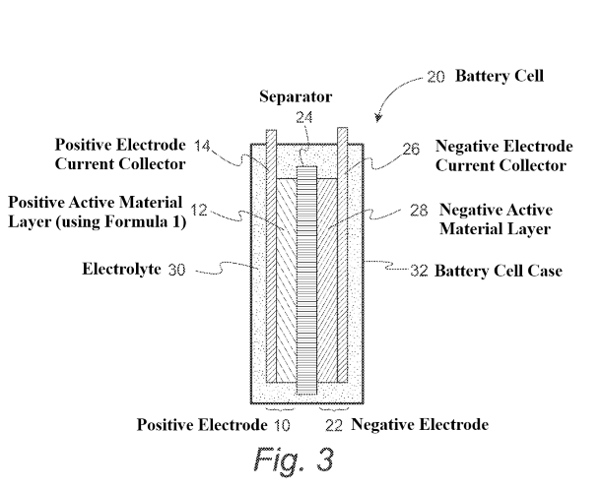
The ’602 patent also describes an exemplary battery cell 20 that incorporates the positive electrode material of Formula 1:
The ’602 patent, Fig. 3 (annotated). As shown above, battery cell 20 is immersed in electrolyte 30 and enclosed in battery cell case 32. Battery cell 20 includes positive electrode 10, negative electrode 22, and separator 24. Negative electrode 22 includes negative electrode current collector 26 and negative active material layer 28. The ’602 patent, 6:16-30. Positive electrode 10 includes positive electrode active material layer 12 and positive electrode current collector 14. The positive electrode active material layer 12 uses the active material represented by Formula 1. The ’602 patent, 5:2-15.
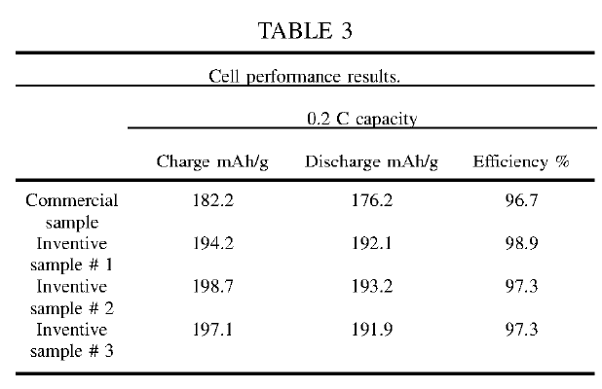
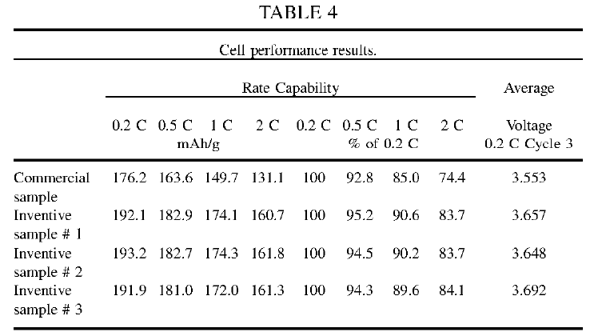
According to the ’602 patent, the positive electrode material of Formula 1 shows higher capacity, higher average voltage, higher rate capacity, and lower voltage decay than the commercial sample, while also demonstrating good cycle performance. The ’602 patent, 9:18-34.
The ’602 patent, 9:35-49 (Table 3).
The ’602 patent, 9:50-67 (Table 4).
Claim 1 of the ’602 patent recites:
A positive electrode active material comprising a compound represented by formula 1:Li₁.₁0Mn₀.₅₂Ni0.38-xMxO₂wherein:M is Co or Cr;2 < average oxidation state of Ni ion < 2.15; and0 < x < 0.06.
The ‘602 patent, 10:29-39.]]>by PV Law LLP<![CDATA[Ghee Lee Named Again to Lawdragon’s List of 500 Next-Generation Lawyers]]>https://www.pvuslaw.com/?p=502382026-06-09T19:44:15Z2026-06-09T19:44:15Z]]>by PV Law LLP<![CDATA[PV Law Named by Chambers AND PARTNERS USA as a Top Ranked PTAB Firm]]>https://www.pvuslaw.com/?p=502362026-06-09T19:44:49Z2026-06-04T21:31:13Z]]>by Jeremy Peterson<![CDATA[Recent Director Decisions Double Down On The Rule that Petitioners Must Justify Different Claim Construction Positions Across Forums]]>https://www.pvuslaw.com/?p=502312026-05-15T19:41:32Z2026-05-15T19:41:32Zprecedential decision and several informative ones, have established and reinforced a rule with significant practical consequences for any company simultaneously defending a patent case in district court while challenging the same patent at the Board.
Revvo Technologies, Inc. v. Cerebrum Sensor Technologies, Inc., IPR2025-00632 — Paper 20 (Nov. 3, 2025) & Paper 36 (Jan. 26, 2026) (Precedential)
In the first Revvo decision, the Director initiated sua sponte review after the Board granted institution despite Revvo having adopted the patent owner's district court construction in the petition, without explaining why its own preferred district court construction was being abandoned. The Board had reasoned that taking inconsistent positions mattered only when means-plus-function terms under 35 U.S.C. § 112(f) were implicated. The Director squarely rejected that narrow reading: the obligation to explain divergent claim construction positions applies across the board, regardless of whether § 112(f) is at issue. The decision vacated institution and remanded for further briefing. In its decision, the Director noted that an example of where a party could make inconsistent claim constructions before the Board and in district court would be “if a party advances a narrow construction in the district court and the court declines to adopt the narrow construction, the party would have sufficient reason for advancing the broader, court-adopted construction in the proceeding before the Board.”
On remand, the Board again granted institution — this time crediting Revvo's argument that it could not wait for the district court's still-pending claim construction ruling before filing a timely petition and that the court could reject the narrower construction. The Director again disagreed and again vacated institution. The Director's January 2026 follow-up order clarified that the “exemplary logic” for permitting divergent constructions is limited to situations where the district court has already rejected a petitioner's preferred construction — not where a petitioner is merely speculating that the district court might do so in the future. Allowing a petitioner to adopt a “wait and see” posture, the Director wrote, is not permitted.
Tesla, Inc. v. Intellectual Ventures II LLC, IPR2025-00340 — Paper 18 (Nov. 5, 2025) (Informative)
In Tesla, the petitioner argued indefiniteness in the district court — contending that a skilled artisan could not determine the meaning of a claim limitation with reasonable certainty — while simultaneously asking the Board to apply “plain and ordinary meaning” to the same limitation. When Patent Owner raised this inconsistency in a Director Review request, the Director vacated institution. Tesla's defense — that it was statutorily prohibited from raising indefiniteness in an IPR — was rejected as insufficient. The Director explained that the statutory bar on indefiniteness challenges in IPRs does not justify adopting a plain-and-ordinary-meaning position before the Board when the petitioner has argued the term cannot be understood in district court. The decision noted that a sufficient explanation might exist if the petitioner had shown that, notwithstanding alleged indefiniteness, a skilled artisan would understand the prior art satisfies the limitation regardless of where the boundaries lie. Tesla made no such showing. The Director noted that indefiniteness could be argued in district court and not in the petition if “an ordinarily skilled artisan would understand that the asserted art satisfies the claim limitation (such as if the limitation prescribed a range and only the outer bounds of the range were unclear).”
Terumo BCT Inc. v. Haemonetics Corp., IPR2025-01374 — Paper 20 (May 12, 2026) (Informative)
Terumo sharpened the rule by adding a timing dimension. Terumo's petitions asserted that claims “need no construction,” but one week after institution was granted, Terumo filed invalidity contentions in district court arguing that claims reciting “controller” were indefinite under § 112(f). The Director found this pattern, advancing inconsistent positions at the first opportunity after institution, paradigmatic of the conduct the rule was designed to prevent. Importantly, the Director framed the inquiry broadly: the question is whether a petitioner's conduct reveals that the IPR is being used not as a “litigation alternative” as Congress intended, but as a vehicle for maintaining inconsistent positions to gain a strategic upper hand in the overall litigation. Institution was vacated.
TikTok, Inc. v. ShopSee, Inc., IPR2025-01485 — Paper 13 (Jan. 16, 2026) (Informative, designated May 13, 2026)
TikTok addressed whether a petitioner can cure the inconsistency problem through post-hoc stipulation. After patent owner raised the indefiniteness vs. plain-meaning discrepancy, TikTok offered to withdraw its indefiniteness arguments from district court if the IPR was allowed to proceed. The Director rejected this as a cure. The decision drew a sharp distinction between two types of stipulations: a stipulation not to pursue in district court the same invalidity grounds raised or reasonably raisable in the IPR, which promotes efficiency and reduces duplication, versus a stipulation merely to stop arguing inconsistently, which only swaps one forum's argument for another’s. The latter provides no systemic benefit, and the Director declined to use it as a basis for maintaining institution.
Ford Motor Company v. AutoConnect Holdings LLC, IPR2025-01342, -01383, -01524 — Paper 27 (May 12, 2026) (Informative)
Ford applied the Terumo framework to a multi-IPR context involving three related patents. After institution was granted, Ford served district court invalidity contentions asserting that seven claim terms across all challenged patents were indefinite — terms it had not construed (or had construed as having plain and ordinary meaning) in the petitions. Ford argued that its indefiniteness positions for two specific terms (“and/or” and “one or more”) fit within the Tesla safe harbor because the prior art would anticipate or render obvious the claims regardless of how those terms were construed. The Director acknowledged that argument but found it unavailing because Ford's indefiniteness contentions reached far beyond those two terms. Ford's offer to stipulate to withdraw all indefiniteness arguments offered only after the violations were brought to the Office’s attention was also rejected under the same rationale applied in TikTok.
Practical Takeaways
Taken together, these decisions establish a clear pattern. A petitioner is not categorically forbidden from advancing different claim construction positions before the PTAB and in district court, but it must explain, in the petition itself, why those different positions are warranted. The explanation must be substantive. Pointing to the statutory bar on indefiniteness challenges in IPRs, asserting that a claim term is “not in controversy,” or noting that district court claim construction is still pending will not suffice.
The two recognized bases for diverging constructions are: (1) where the district court has already rejected the petitioner’s preferred narrower construction, prompting a broader position before the Board, and (2) in the indefiniteness context, where a limitation prescribed a range and only the outer bounds of the range were unclear.
The decisions also signal that the timing and sequencing of how inconsistent positions come to light matters. Petitioners who adopt a plain-and-ordinary-meaning posture in a petition and then assert indefiniteness in district court contentions served after institution, even one week after, will find that the Director views such conduct as evidence that the IPR is being used strategically rather than as a genuine alternative to litigation. Moreover, a post-hoc offer to withdraw the inconsistent position, offered only once caught, will not restore institution.
For legal departments and outside counsel managing parallel IPR and district court proceedings, the practical implication is straightforward: claim construction strategy must be unified and considered before the petition is filed, not after. If there is a legitimate reason to advance different constructions in the two forums, that reason must be articulated in the petition. Finally, if indefiniteness will be a meaningful argument in district court, counsel should carefully assess whether and how to proceed with an IPR petition on the same claims.]]>by <![CDATA[Technology Spotlight: Beam Global’s EV Charging System Using Wind Turbine and Solar Panel]]>https://www.pvuslaw.com/?p=502292026-05-15T19:37:05Z2026-05-14T18:54:21Z
The ’851 patent, Fig. 1 (annotated). According to the ’851 patent, the wind turbine 14 rotates around the vertical axis 32 through an angle ψ in response to the reaction of a weathervane 34, id. at 5:58-64, while the solar panel rotates through a predetermined directional angle θ and a predetermined inclination angle Φ via a motor (not shown in Fig. 1) in accordance with a predetermined schedule, id. at 6:9-16. The patent discloses that the predetermined schedule is established based on the time of day and the path of the sun during the day. Id. at 3:27-36.
The ’851 patent contemplates that the system may be permanently installed at a specific location and connected to operate with a public grid, or configured as a mobile unit that can be periodically repositioned. The ’851 patent, 2:34-39.
Claim 1 of the ’851 patent recites:
A system for generating renewable energy, the system comprising:a support base defining a support axis, wherein the support axis is vertical;an extension arm mounted to the support base, wherein the extension arm has an end extending outward from the support base, and the extension arm rotates about the support axis;a solar panel mounted to an attachment point at the end of the extension arm, wherein a first portion of the solar panel extends above the attachment point and the extension arm, a second portion of the solar panel extends below the attachment point and the extension arm, and the solar panel is rotatable through an inclination angle about the attachment point;a first motorized mechanism configured to rotate the extension arm about the support axis;a second motorized mechanism mounted at the end of the extension arm, and connected with the solar panel for rotating the solar panel through the inclination angle;a controller in combination with the first motorized mechanism and the second motorized mechanism, and the controller and the first motorized mechanism collectively configured to rotate the solar panel along a directional arc about the support axis to keep the solar panel facing a direction toward the sun; anda wind turbine mounted with respect to the extension arm and/or the support base, wherein the wind turbine rotates about a turbine axis that is parallel to the support axis, wherein the wind turbine also rotates around the support axis so that the wind turbine is and remains down-sun of the solar panel during a rotation of the solar panel along the directional arc to prevent the wind turbine from shading the solar panel, and the wind turbine is mounted above the support base and/or the solar panel whereby the solar panel does not block wind from contacting the wind turbine during the rotation along the directional arc.
The ’851 patent, 8:29-67.]]>by Bradford Cangro<![CDATA[Standard-Based Infringement Evidence Can Be Element-by-Element]]>https://www.pvuslaw.com/?p=502052026-04-30T20:20:17Z2026-04-30T20:20:17ZIntroduction
In Constellation Designs, LLC v. LG Electronics Inc., Case No. 2024-1822, the Federal Circuit affirmed the Eastern District of Texas’s denial of LG’s motion for judgment as a matter of law on non-infringement, holding that Constellation could prove infringement by relying on industry-standard evidence for some claim limitations and product-specific evidence for others within the same claim. The court also concluded that substantial evidence supported the jury’s infringement verdict against LG’s ATSC 3.0-compatible televisions.
Background
Constellation Designs, LLC sued LG Electronics Inc. and its affiliates in the Eastern District of Texas for willful infringement of patents related to non-uniform signal constellations used in digital communication systems. At trial, Constellation accused LG televisions that were compatible with the ATSC 3.0 broadcast standard, particularly protocol A/322, of infringing the asserted patents. After the jury found infringement, LG moved for JMOL of non-infringement, arguing that Constellation had improperly mixed two different proof models: standards-based evidence for some claim elements and direct product evidence for others.
LG’s argued that under Fujitsu Ltd. v. Netgear Inc., 620 F.3d 1321 (Fed. Cir. 2010), a patentee may rely on a standard to prove infringement only when the standard satisfies every limitation of the asserted claim, not merely a subset of limitations. Constellation countered that nothing in Fujitsu or its progeny prohibits a patent owner from relying on standard-compliance evidence for some limitations while using direct product evidence for others.
The district court rejected LG’s argument and agreed with Constellation, holding that nothing prevents a plaintiff from using a standard-based read for some limitations and a direct comparison to the accused products for other limitations of the same claim, so long as the evidentiary showing is sufficient. Further, the district court found substantial evidence supported the jury’s verdict and denied LG’s JMOL.
Federal Circuit Analysis
The Federal Circuit agreed with the district court’s reading of Fujitsu and held that its logic can apply on a limitation-by-limitation basis rather than only at the full-claim level. According to the court, when a standard is (1) sufficiently specific and (2) mandatory, or if optional, shown to be implemented in the accused product, a patentee may use the standard to prove satisfaction of that particular limitation, while relying on separate product evidence for the remaining limitations.
The court gave two reasons for agreeing with the district court. First, it emphasized efficiency: if a group of products practices the same standard, it would waste judicial resources to separately re-prove the same limitation product by product when the standard itself establishes that limitation. Second, the same safeguards identified in Fujitsu still apply in this narrower setting, namely that the relevant portion of the standard must be specific enough to show that practicing it necessarily satisfies the limitation, and that the relevant provision must be mandatory or affirmatively implemented if optional. The Federal Circuit found no textual or logical basis in Fujitsu or its progeny that would restrict those principles to whole-claim analysis. LG’s argument that this approach "vitiate[d] Fujitsu" was rejected.
The Federal Circuit also held that substantial evidence supported the jury’s verdict. The court noted that LG’s own technical expert acknowledged the accused televisions were ATSC 3.0-compatible. Constellation’s expert testified based on physical testing, source code, ATSC documents, and LG’s internal records that all accused televisions could receive ATSC 3.0 signals using the same patented constellations embedded in the standard. LG’s own corporate representative confirmed that LG chips implement the A/322 protocol, which the FCC has mandated for ATSC 3.0 television receivers. Given this record, the Federal Circuit concluded substantial evidence supported the infringement verdict.
Conclusion
The Federal Circuit has now made clear that standard-based infringement proof is not an all-or-nothing exercise. In the right case, a patentee may use an industry standard to establish some limitations and product-specific evidence to establish others, provided the Fujitsu requirements are satisfied for each standard-based limitation.]]>by Bradford Cangro<![CDATA[Federal Circuit Dismisses Petitioner’s Appeal of PTAB Decision on Amended Claims for Lack of Standing]]>https://www.pvuslaw.com/?p=502042026-04-11T20:46:34Z2026-04-11T20:46:34ZIntroduction
In ironSource Ltd. v. Digital Turbine, Inc., the Federal Circuit dismissed an appeal from a Patent Trial and Appeal Board (PTAB) decision on the ground that the petitioner lacked Article III standing. The court held that ironSource failed to demonstrate a concrete and particularized injury in fact. Specifically, ironSource did not establish a sufficient risk of infringement tied to the amended patent claims at issue, which precluded appellate review.
Background
Digital Turbine (DT) owns U.S. Patent No. 11,157,256, directed to technology for installing mobile applications in the background. ironSource petitioned for post-grant review (PGR) challenging the original claims (1–22) on various statutory grounds. During the proceeding, DT filed an initial and revised motions to amend, proposing substitute claims (23–37) that added narrowing limitations.
The Patent Trial and Appeal Board (PTAB) ultimately determined that (1) the original claims were unpatentable; and (2) the substitute claims in the revised motion were patentable because ironSource failed to show, by a preponderance of the evidence, that those amended claims were unpatentable.
ironSource appealed the PTAB’s decision upholding the substitute claims. Before the Federal Circuit, the dispute centered on whether ironSource had Article III standing to pursue the appeal.
ironSource argued it had standing based on a risk of future infringement liability. It pointed to alleged “veiled threats” by DT suggesting that ironSource’s prior product (Aura), particularly its “Click-to-Install” features, infringed DT’s patents. ironSource asserted that these threats forced it to modify its product and business practices and that it wished to reintroduce similar functionality but was deterred by the PTAB’s decision upholding the amended claims.
DT countered that ironSource lacked standing because it failed to demonstrate a concrete and particularized injury. Specifically, DT argued that ironSource had not shown any current or imminent activity that would infringe the substitute claims, nor had it established a sufficient connection between its prior product features and the newly amended claims at issue.
Federal Circuit’s Decision
The Federal Circuit agreed with DT that irconSource lacked standing and dismissed the appeal for lack of Article III standing.
The Federal Circuit reiterated that, while a party need not establish standing to initiate a PTAB proceeding, it must demonstrate standing to appeal an adverse decision. To do so, the appellant must show a concrete and particularized injury that is actual or imminent, such as a substantial risk of future infringement liability. The party must have standing at the time the appeal is filed.
The Federal Circuit found that ironSource did not meet this burden for several reasons:
No Concrete Plans for Potentially Infringing Activity
Although ironSource had previously developed and marketed a product (Aura) with “Click-to-Install” features, the Federal Circuit found no evidence of concrete plans to reintroduce those features in a manner that would implicate the substitute claims.
Failure to Link Product Features to the Amended Claims
The Federal Circuit emphasized that the relevant inquiry must focus on the substitute claims, which included additional narrowing limitations. ironSource failed to demonstrate how its prior or contemplated product features would satisfy those specific limitations.
Insufficient Evidence of Imminent Infringement Risk
ironSource relied on a declaration describing DT’s alleged “veiled threats” and past business impacts. However, the Federal Circuit found this evidence insufficient because it did not establish a concrete and particularized risk of infringement tied to the claims at issue.
The Federal Circuit rejected ironSource’s contention that past allegations and business impacts alone were sufficient to establish standing. The Federal Circuit found that such assertions must be supported by evidence connecting the alleged risk of infringement to the specific claim limitations at issue, which is something ironSource failed to do.
Because ironSource failed to establish standing, the Federal Circuit did not reach the merits of the PTAB’s decision and dismissed the appeal for lack of jurisdiction.
Conclusion
This decision reinforces the principle that just because a party is able to file a petition for review at the PTAB does not mean it will be able to appeal an adverse decision by the Board. Moreover, the issue of standing can be particularly problematic with respect to amended or substituted claims. Finally, generalized assertions of past disputes or business concerns may be insufficient. When an appellant who is challenging the validity of a patent relies on potential infringement liability as a basis for injury in fact, it should be prepared to show concrete plans for potentially infringing activity and a clear nexus between that activity and the specific claim limitations.]]>
 The ’602 patent, Fig. 3 (annotated). As shown above, battery cell 20 is immersed in electrolyte 30 and enclosed in battery cell case 32. Battery cell 20 includes positive electrode 10, negative electrode 22, and separator 24. Negative electrode 22 includes negative electrode current collector 26 and negative active material layer 28. The ’602 patent, 6:16-30. Positive electrode 10 includes positive electrode active material layer 12 and positive electrode current collector 14. The positive electrode active material layer 12 uses the active material represented by Formula 1. The ’602 patent, 5:2-15.
According to the ’602 patent, the positive electrode material of Formula 1 shows higher capacity, higher average voltage, higher rate capacity, and lower voltage decay than the commercial sample, while also demonstrating good cycle performance. The ’602 patent, 9:18-34.
The ’602 patent, Fig. 3 (annotated). As shown above, battery cell 20 is immersed in electrolyte 30 and enclosed in battery cell case 32. Battery cell 20 includes positive electrode 10, negative electrode 22, and separator 24. Negative electrode 22 includes negative electrode current collector 26 and negative active material layer 28. The ’602 patent, 6:16-30. Positive electrode 10 includes positive electrode active material layer 12 and positive electrode current collector 14. The positive electrode active material layer 12 uses the active material represented by Formula 1. The ’602 patent, 5:2-15.
According to the ’602 patent, the positive electrode material of Formula 1 shows higher capacity, higher average voltage, higher rate capacity, and lower voltage decay than the commercial sample, while also demonstrating good cycle performance. The ’602 patent, 9:18-34.
 The ’602 patent, 9:35-49 (Table 3).
 The ’602 patent, 9:50-67 (Table 4).
Claim 1 of the ’602 patent recites:
The ’602 patent, 9:50-67 (Table 4).
Claim 1 of the ’602 patent recites: