

On March 24, 2026, Mehrdad Naderian obtained U.S. Patent No. 12,583,340 titled “Charging Apparatus for Electric Vehicles” (“the ’340 patent”). The patent discloses a system that uses magnetic bars embedded in the surface of roadways to charge electric vehicles as they drive over the bars at a designated speed. The ’340 patent, Abstract.
According to the ’340 patent, the biggest obstacle of current EV infrastructure is stationary charging stations that require vehicles to stop for extended periods. The ’340 patent, 2:20-27. Existing solutions such as wireless charging pads require additional power supply and can be too costly or simply not practical or feasible. Id. at 2:27-31.
The ’340 patent proposes installing magnetic bars flush with the surface of pavements. Figure 1 illustrates an electric vehicle travelling over magnetic bars:
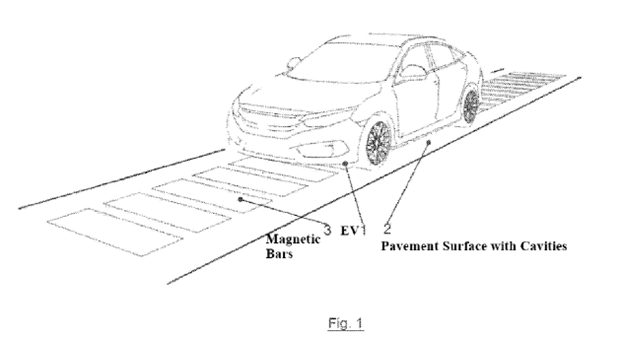
The ’340 patent, Fig. 1 (annotated).
Figure 2 illustrates the EV with the winding coil retracted in its housing (not in use):
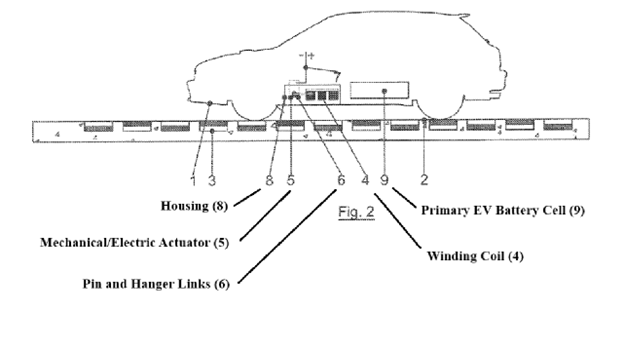
The ’340 patent, Fig. 2 (annotated).
Figure 4 illustrates the EV with the winding coil extended down to hover over the magnetic bars (in charging mode):
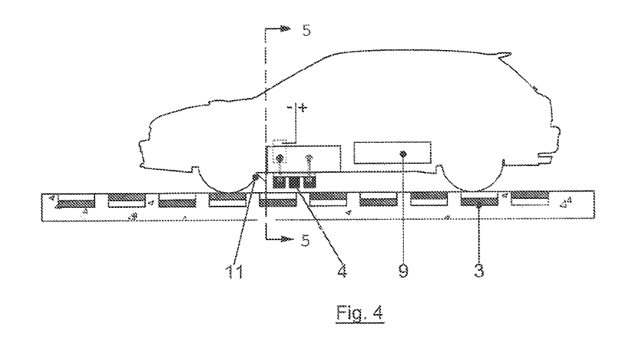
The ’340 patent, Fig. 4.
The proposed charging system of the ’340 patent allows an electric vehicle to charge while driving over the lane(s) with embedded magnetic bars. The ’340 patent, 3:57-58. To activate charging, the patent proposes a switch located on the dash that lowers the winding coil, or alternatively, sensors that automatically perform this function. Id. at 3:58-61.
Claim 1 recites:
The invention claimed is an electric vehicle (EV) charging apparatus, comprising:
magnetic bars embedded in a surface of a pavements [sic], and [sic]
a winding coil mounted beneath the EV by pin and hanger links,
an actuator configured to lower the winding coil over the wireless magnetic bars,
and wherein said pavement is indented with cavities previously saw cut to house the magnetic bars.
The ’340 patent, 4:37-46.