

On November 25, 2025, Zhuhai CosMX Battery Co., Ltd. obtained US Patent No. 12,482,824 (“the ’824 patent”), titled “Positive Electrode Plate and Lithium-Ion Battery Comprising the Positive Electrode Plate.” According to the ’824 patent, mechanical damage such as acupuncture or weight impact can cause an internal short circuit in lithium-ion batteries. The ’824 patent, 1:31-35. Of the multiple short circuit modes, the patent identifies a short circuit between the positive current collector foil and the negative electrode plate as the most dangerous. Id. at 1:36-40.
The ’824 patent’s purported solution is a positive electrode current collector with two coating layers. The ’824 patent, 4:51-54. According to the patent, the first coating layer is coated on the positive electrode current collector surface, and includes an inorganic filler, a first conductive agent, and a first binder. A portion of this first binder bonds to the positive electrode current collector. Id. at 4:55-65.
Further according to the ’824 patent, the second coating layer is coated on the first coating layer surface, and includes a positive electrode active material, a second conductive agent, and a second binder. A part of the positive electrode active material bonds with a different portion of the first binder. The ’824 patent, 4:55-67.
The ’824 patent requires the content of the first binder exceed the content of the second binder, and that the positive electrode plate satisfy at least one of several structural conditions relating to bonding force or residual coating thickness or mass after peeling. The ’824 patent, 4:62-5:38.
Figure 10 provides an SEM of an exemplary electrode plate. It illustrates that the large-diameter particles (positive electrode active material) of the top layer (second coating layer) become embedded in the bottom layer (first coating layer) due to rolling pressure. As a result, part of the first binder in the bottom layer contacts the positive electrode current collector, while another part of the first binder contacts the large-diameter particles in the top layer. The ’824 patent, 14:8-17.
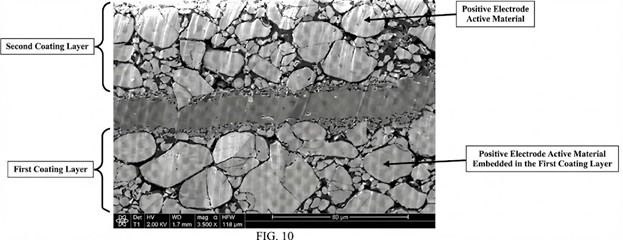
The ’824 patent, Fig. 10 (annotated).
The’824 patent states that the benefit of this arrangement is that when the positive electrode coating layer peels off during mechanical misuse such as acupuncture or weight impact, the first coating layer protects the positive electrode current collector surface from exposure. This protection reduces the probability that the positive electrode current collector will come into contact with the negative electrode. The ’824 patent, 3:5-19.
Claim 1 of the ’824 patent recites:
A positive electrode plate, comprising: a positive electrode current collector and a positive electrode coating layer, wherein
the positive electrode coating layer comprises a first coating layer and a second coating layer, wherein the first coating layer is coated on a surface of the positive electrode current collector, and the second coating layer is coated on a surface of the first coating layer;
the first coating layer comprises an inorganic filler, a first conductive agent and a first binder; the second coating layer comprises a positive electrode active material, a second conductive agent and a second binder;
a content of the first binder in the first coating layer is greater than a content of the second binder in the second coating layer;
wherein the positive electrode active material in the second coating layer is embedded in the first coating layer, the positive electrode current collector is bonded with a part of the first binder, and a part of the positive electrode active material is bonded with another part of the first binder; and
wherein the inorganic filler comprises ceramic materials.
The ’824 patent, 16:53-17:7.