

On April 7, 2026, Ford Global Technologies, LLC obtained U.S. Patent No. 12,597,602 titled “Lithium and Manganese Rich Positive Active Material Compositions” (“the ’602 patent”). The patent describes positive electrode active materials for lithium-ion batteries that provide increased capability, improved cell performance, and greater volumetric energy density. The ’602 patent, 1:21-28.
Specifically, the ’602 patent describes a positive electrode active material represented by the formula Li1.10Mn0.52Ni0.38-xMxO2 (“Formula 1”). In Formula 1, M is cobalt (Co) or chromium (Cr), the average oxidation state of the nickel ion is between 2 and 2.15, and the substituent amount x is between 0 and 0.06. The ’602 patent, 1:30-38.
The ’602 patent also describes an exemplary battery cell 20 that incorporates the positive electrode material of Formula 1:
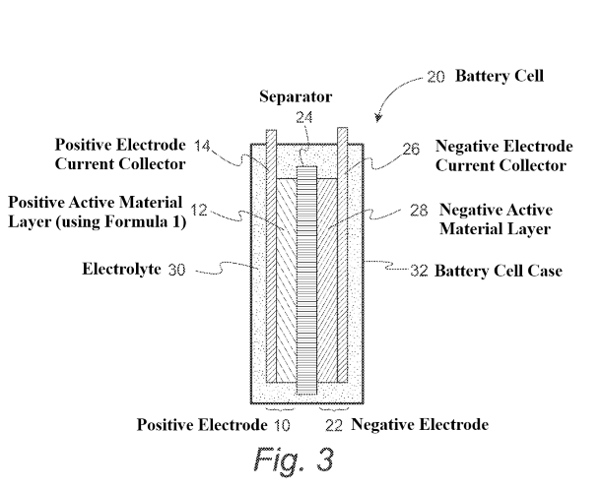
The ’602 patent, Fig. 3 (annotated). As shown above, battery cell 20 is immersed in electrolyte 30 and enclosed in battery cell case 32. Battery cell 20 includes positive electrode 10, negative electrode 22, and separator 24. Negative electrode 22 includes negative electrode current collector 26 and negative active material layer 28. The ’602 patent, 6:16-30. Positive electrode 10 includes positive electrode active material layer 12 and positive electrode current collector 14. The positive electrode active material layer 12 uses the active material represented by Formula 1. The ’602 patent, 5:2-15.
According to the ’602 patent, the positive electrode material of Formula 1 shows higher capacity, higher average voltage, higher rate capacity, and lower voltage decay than the commercial sample, while also demonstrating good cycle performance. The ’602 patent, 9:18-34.
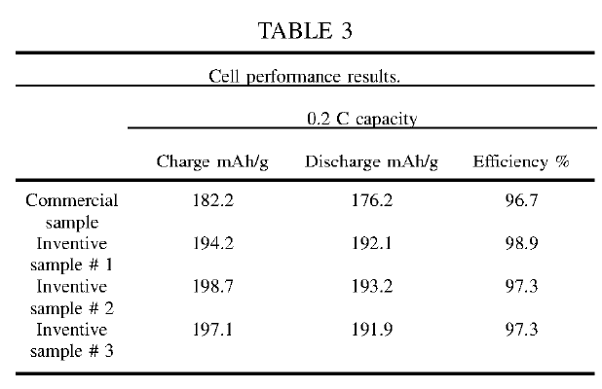
The ’602 patent, 9:35-49 (Table 3).
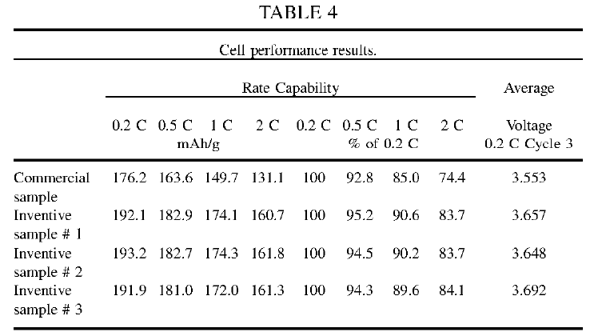
The ’602 patent, 9:50-67 (Table 4).
Claim 1 of the ’602 patent recites:
A positive electrode active material comprising a compound represented by formula 1:
Li₁.₁0Mn₀.₅₂Ni0.38-xMxO₂
wherein:
M is Co or Cr;
2 < average oxidation state of Ni ion < 2.15; and
0 < x < 0.06.
The ‘602 patent, 10:29-39.