

On December 23, 2025, LG Energy Solution, Ltd. and the Regents of the University of California obtained U.S. Patent No. 12,506,174, titled “Solid Electrolyte Membrane, Method for Manufacturing the Same, and All-Solid-State Battery Comprising the Same” (“the ’174 patent”). The patent introduces a solid electrolyte membrane that purportedly improves strength while maintaining ionic conductivity. The ’174 patent, 2:30-32. Specifically, the solid electrolyte membrane includes two stacked solid electrolyte layers, in which the binder content of one layer is set at a lower level than that of the other. Id. at 2:22-25.
Figure 1 of the ’174 patent illustrates a longitudinal cross-section of an exemplary solid electrolyte membrane:
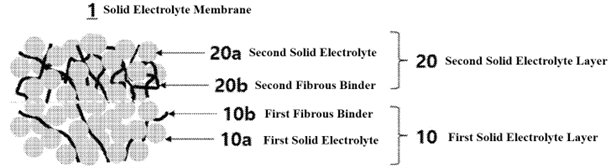
The ’174 patent, Fig. 1 (original labels moved, annotations added).
The solid electrolyte membrane 1 of Figure 1 is described as having a first solid electrolyte layer 10, and a second solid electrolyte layer 20 formed on one side of the first solid electrolyte layer 10. The two solid electrolyte layers 10, 20 each include a solid electrolyte, identified as 10a and 20a respectively, and a fibrous binder, identified as 10b and 20b respectively.
According to the ’174 patent, the weight of the first fibrous binder 10b relative to the total weight of the first solid electrolyte layer 10 is less than the weight of the second fibrous binder 20b relative to the total weight of the second solid electrolyte layer 20. The ’174 patent, 5:11-23. For example, the first fibrous binder may be present at 1% by weight or less of the total weight of the first solid electrolyte layer. The ’174 patent emphasizes that the first solid electrolyte layer has a lower content of the binder than the adjacent second solid electrolyte layer. Id. at 5:19-23. For example, the second fibrous binder may be contained in an amount of up to 2% by weight. Id. at 5:53-63. According to the ’174 patent, under this configuration, when the first solid electrolyte layer is in contact with the negative electrode, the occurrence of side reactions at the interface with the negative electrode may be prevented. Id. at 5:24-33.
The ’174 patent further specifies that the two solid electrolyte layers may be manufactured using a dry process that is substantially solvent-free. The ’174 patent, 8:7-9. In this dry process, the binder may be fiberized from an initial particle form by physically stretching it without using a solvent. As a result, the physical properties of the solid electrolyte membrane may be improved compared to membranes produced using a wet process, in which a solvent may dissolve the binder. Id. at 8:30-56.
Claim 1 of the ’174 patent recites:
A solid electrolyte membrane, comprising:
a first solid electrolyte layer; and
a second solid electrolyte layer on one side of the first solid electrolyte layer,
wherein the first solid electrolyte layer comprises a first solid electrolyte and a first fibrous binder, wherein a weight of the first fibrous binder is 0.1% by weight to 0.4% by weight based on a total weight of the first solid electrolyte layer,
wherein the second solid electrolyte layer comprises a second solid electrolyte and a second fibrous binder, wherein a weight of the second fibrous binder is 0.2 to 0.9% by weight based on a total weight of the second solid electrolyte layer,
wherein the weight of the first fibrous binder relative to the total weight of the first solid electrolyte layer is less than the weight of the second fibrous binder relative to the total weight of the second solid electrolyte layer,
wherein the first fibrous binder and the second fibrous binder each independently comprise at least one selected from the group consisting of polytetrafluoroethylene (PTFE), ethylene-vinyl acetate (EVA), styrene-ethylene-butylene-styrene (SEBS) and copolymers thereof,
wherein a thickness of the solid electrolyte membrane is 20 μm to 700 μm, and
wherein no solvent is used in the preparation of the first and second solid electrolyte layers.
The ’174 patent, 20:40-67.